
Research Paper Workspace
Ask questions about research papers and examine the evidence behind each answer.
- Shruti Chatterjee
- Jamal Hossain
- Talibul Haque Khan


- Retrieval-Augmented Generation
- Research Papers
- ChromaDB
- RAGAS
- Ollama
- Streamlit
From papers to answers you can inspect
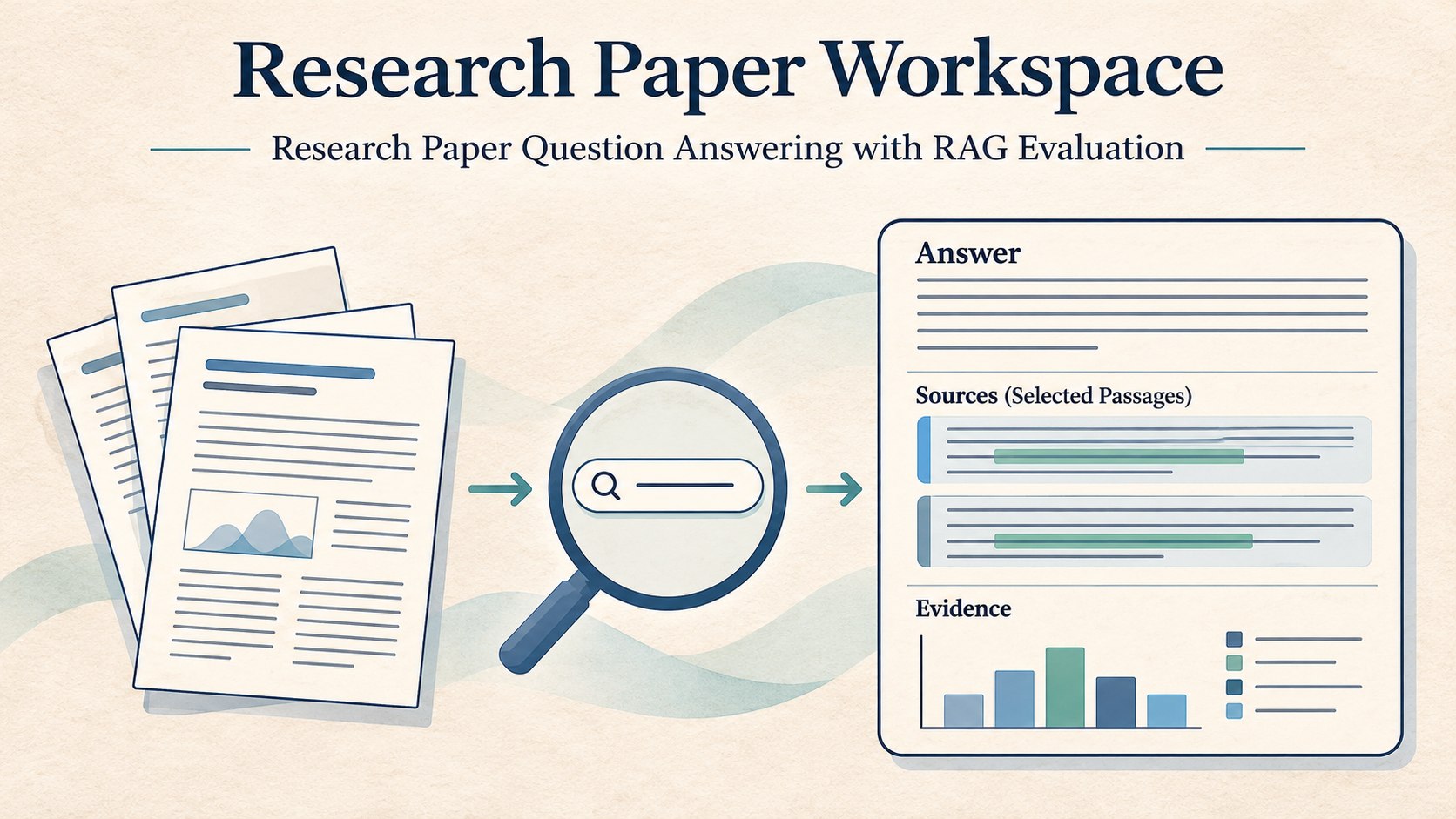
Finding an answer in a research paper often means searching through pages of methods, definitions, and results. Research Paper Workspace brings PDF processing, passage retrieval, answer generation, and quality checks into a single interface.
The project uses retrieval-augmented generation to give a local language model relevant passages from a paper before it answers a question. Users can inspect those passages alongside the generated answer and request RAGAS evaluation of its faithfulness and relevance.
What you can do
- Upload a research PDF. Extract its text, identify sections, and turn the content into searchable chunks.
- Ask a natural-language question. Retrieve relevant passages through semantic search.
- Inspect the answer and its context. Read the generated response alongside the passages supplied to the model.
- Run quality checks when needed. Request faithfulness and answer relevancy scores through an optional evaluation step.
How it works
The ingestion pipeline uses PyMuPDF to extract PDF text, detects section boundaries, creates overlapping chunks, and generates embeddings with all-MiniLM-L6-v2. ChromaDB stores the chunk texts, embeddings, and document metadata.
For each question, dense retrieval selects the three most relevant passages. A locally hosted Llama 3.1 8B model, accessed through Ollama, receives the question and those passages with instructions to answer from the provided context and acknowledge missing information.
The Streamlit interface displays retrieved passages in expandable panels, followed by the generated answer. RAGAS evaluation can be enabled separately to assess how well the answer is supported by its context and how directly it addresses the question.
A closer look at answer quality
The team's demonstration evaluated the question "What is RAGAS and what does it evaluate?" and recorded the following results:
Faithfulness checks whether generated claims are supported by the retrieved passages. Answer relevancy checks how closely the response addresses the question. These automated scores describe one illustrative example; a wider question set and human review are needed to assess performance across papers and topics.
Both the answer generator and evaluation model are configured with temperature zero to reduce variation between runs. Outputs and judge scores can still depend on the model, retrieved context, and execution settings.
The people behind the project
- Shruti Chatterjee: dense retrieval, answer generation, RAGAS evaluation, the Streamlit interface, and the technical report.
- Jamal Hossain: PDF ingestion, section detection, chunking, embeddings, and the handoff to vector storage.
- Talibul Haque Khan: a proposed hybrid retrieval design combining dense retrieval and BM25 with reciprocal rank fusion. This enhancement remains separate from the demonstrated pipeline.
Research supervision: Md Sultanul Islam Ovi.
Where the project can grow
The current prototype focuses on PDF question answering and answer evaluation. CPU-based evaluation can take several minutes, so it runs only when requested. Source passages and automated scores support review, while important claims still need checking against the original paper.
Next steps include integrating hybrid retrieval, expanding evaluation with human-checked questions, and exploring shared collections, participant accounts, and broader cross-paper workflows.
Explore the project
The implementation uses Python, PyMuPDF, sentence-transformers, ChromaDB, LangChain, Ollama, RAGAS, and Streamlit.
Browse the source code, explore the presentation and demo, or read the technical report.