
Robust Multimodal Temporal Learning under Missing and Asynchronous Modalities
Learning from multiple streams when observations arrive at different times or go missing.
- Nada Belarbi
- Rifat Faruk Zitu
- Anup Sen
- Shahriar Sakib




- Multimodal Learning
- Time Series
- Missing Data
- Temporal Attention
- PyTorch
- Streamlit
Making availability part of the model
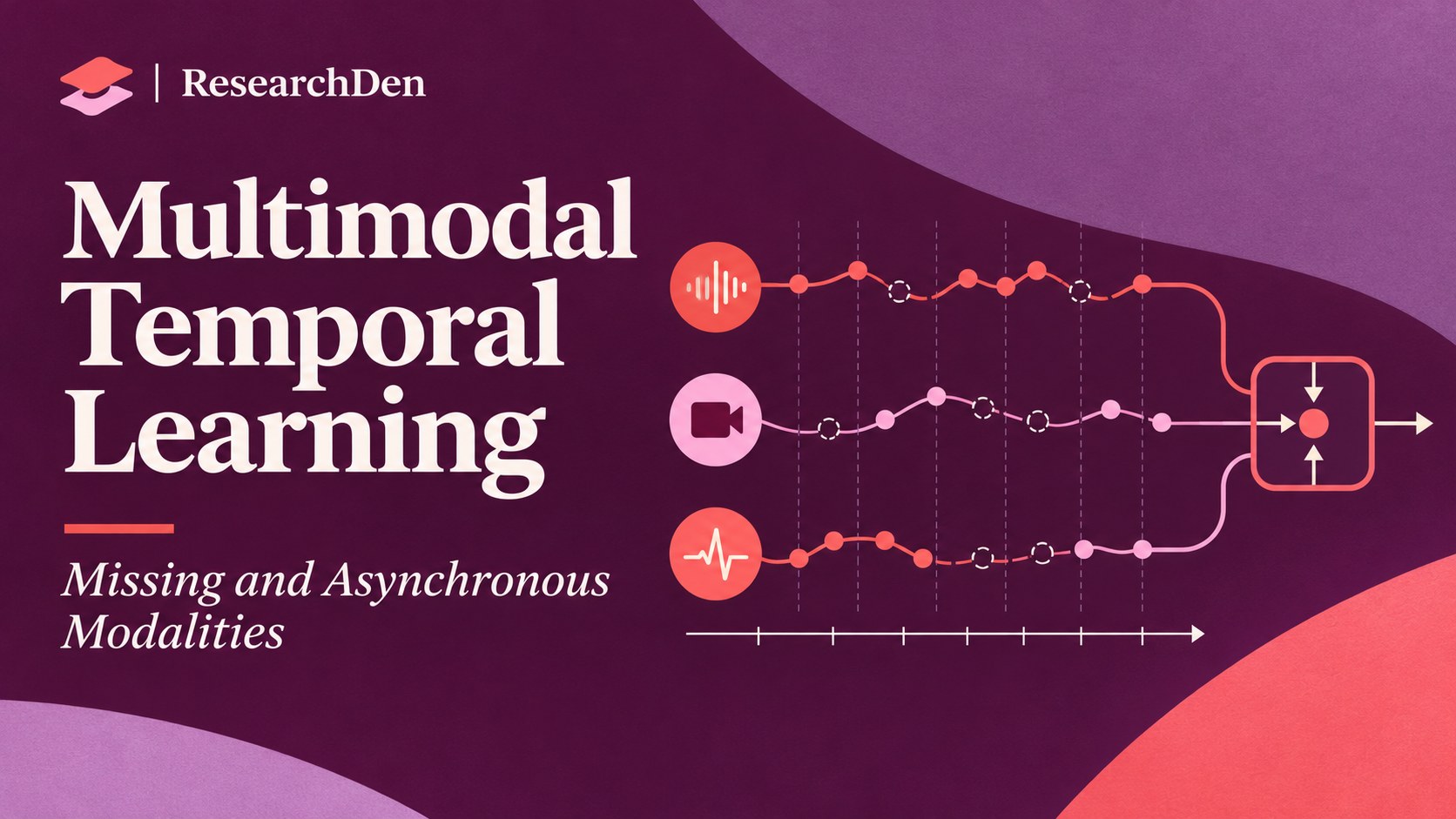
A wearable sensor can stop recording, while audio, language, and visual features may become usable at different times. Combining these streams requires knowing which observations were actually available when a decision was made.
This project develops a shared framework for those conditions and evaluates it through two applications: PAMAP2 physical activity recognition and CMU MOSI sentiment classification. The completed experiments compare fusion strategies, test selected missingness and delay scenarios, and replay saved decisions.
One temporal pipeline, two applications
Each source retains its values, validity mask, event interval, availability time, and observation identifier. At a decision point, the selector includes only observations available by that time and fully contained within the history window. Normalization is fitted on eligible training observations.
- PAMAP2: hand, chest, ankle, and heart-rate streams support recognition of 12 activities using five-second histories. Replay simulates reception time from event time.
- CMU MOSI: language, audio, and visual features support binary sentiment classification. Predictions use completed segments, making this an offline setting.
Three approaches to fusion
Separate projection and GRU encoders summarize each source. The three variants then combine the available evidence differently:
- V0, late fusion: averages the available source classifiers' probabilities.
- V1, gated fusion: learns masked weights over source summaries.
- V2, attention fusion: applies temporal attention within sources and attention across source representations.
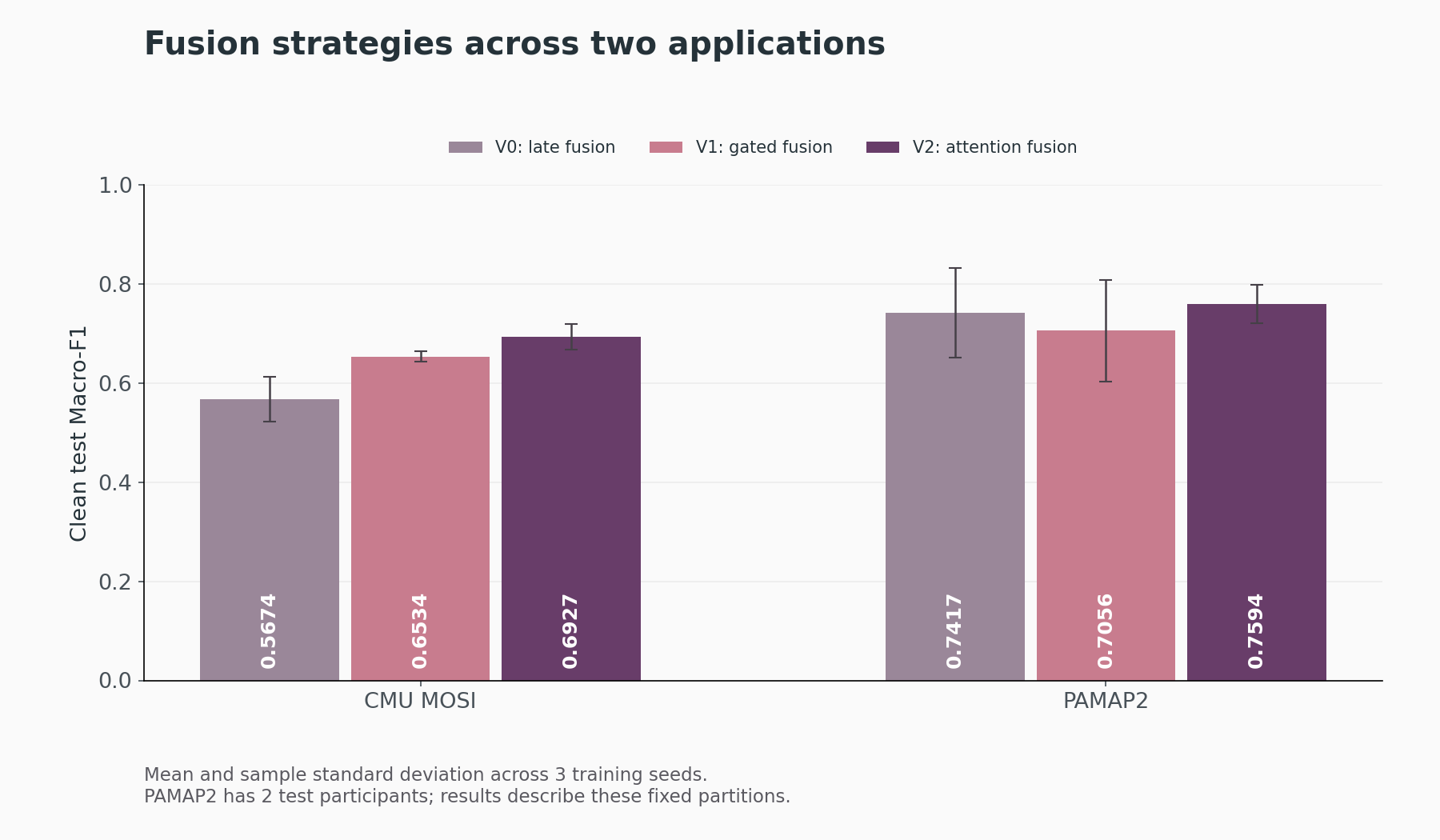
The clean campaign trained each variant on both applications with seeds 11, 22, and 33, producing 18 runs. Checkpoints were selected on validation data. The robustness extension reuses the saved checkpoints rather than retraining them.
Explore the saved experiments
The executed experiment walkthrough includes result tables, visual comparisons, calibration diagnostics, and replay measurements. The source also includes a local Streamlit reviewer interface for auditing sequences, comparing runs, and inspecting replay traces when the saved run artifacts are available.
Across three seeds, V2 had the highest mean clean test Macro-F1 on both applications: 0.6927 on MOSI and 0.7594 on PAMAP2. Macro-F1 gives equal weight to each class. MOSI's V2 improvement over V0 was positive for every saved seed; PAMAP2's difference changed sign across seeds.
Missing observations, delay, and replay
The saved scenarios include absent sources, leave-one-source-out evaluation, global observation removal, and added delay. With 30% of observations removed globally, V2's mean Macro-F1 was 0.6557 on MOSI and 0.7591 on PAMAP2.
Availability coverage matters alongside predictive quality. Every tested positive delay makes MOSI's inputs unavailable at its segment-closure decision point, so those cases have zero coverage and undefined quality. PAMAP2 behaves differently: the tested 25% delay condition retains full coverage.
All 54 final whole-test replay traces matched their saved references on identifiers, masks, classes, status, and computability. Numerical differences observed in 563 batch-size-32 comparisons were rechecked successfully at batch size one. The result supports that replay workflow; it does not establish exact equivalence across batch sizes.
Reading the results in context
These findings describe fixed partitions and selected perturbations. PAMAP2 has only two test participants, and its partition used class-count stratification across recordings. MOSI groups by video without verified speaker independence, and one development video is missing.
Six of 18 temperature-calibration fits fell back to an identity temperature, and no abstention policy is enabled. Confidence quality therefore needs separate evaluation. Robust retraining, the full perturbation matrix, and formal predictive qualification remain future work. The higher V2 means do not establish a universal architecture winner.
Explore the project
The implementation uses Python, PyTorch, NumPy, pandas, Pydantic, and Streamlit. Browse the source code, open the experiment walkthrough, or inspect the exported figures and tables.